
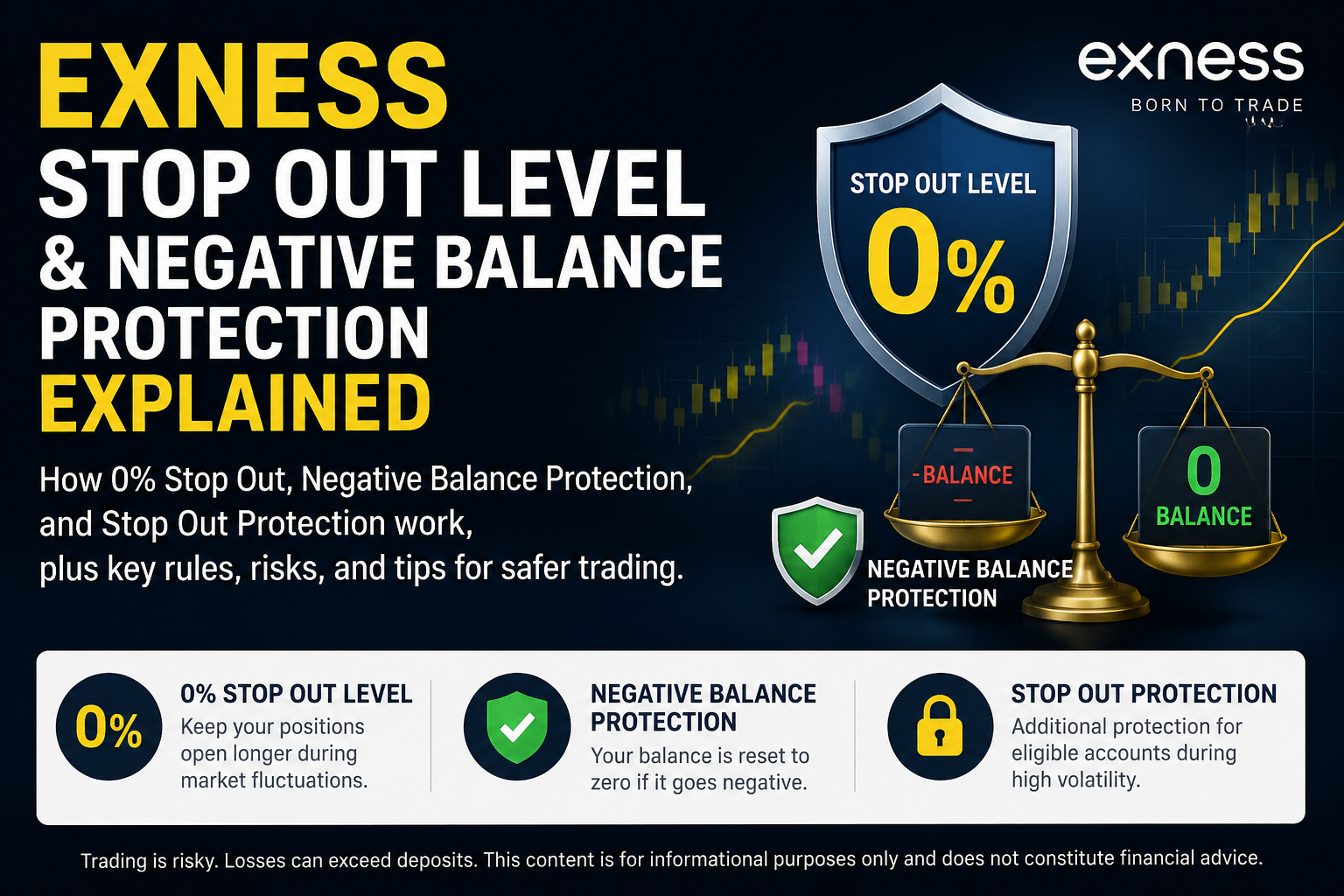
When trading with high leverage on Exness, two risk-management mechanisms are especially important to understand: Stop Out and Negative Balance Protection.
Exness offers a 0% stop out level on many account types and under many applicable entities/regions. It also provides Negative Balance Protection, which is designed to reset an eligible trading account’s negative balance to zero if extreme market conditions cause the balance to fall below zero.
However, a 0% stop out level does not mean trading is safe until your margin level reaches zero. High leverage can magnify losses from relatively small price movements, so position sizing and risk management remain essential.
This guide explains how Exness stop out works, how margin level is calculated, what Negative Balance Protection and Stop Out Protection do, the main risks traders should understand, and how active traders may reduce effective trading costs.
What Is the Exness Stop Out Level?
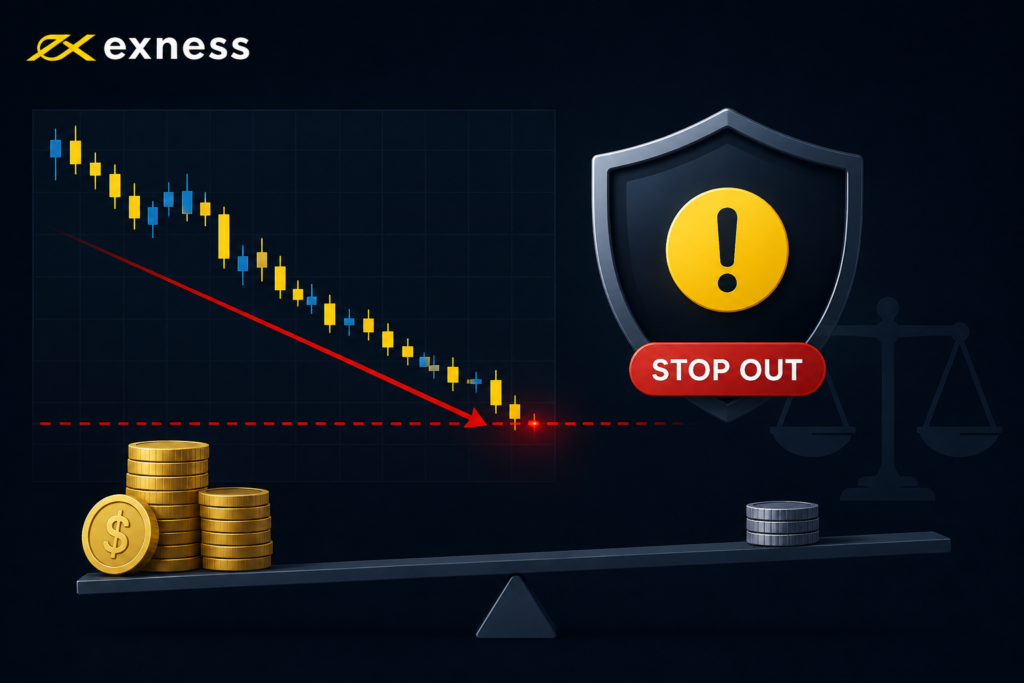
A stop out is the automatic closure of open positions when losses reduce the account’s margin level to the broker’s specified stop out threshold.
On many Exness accounts, the standard stop out level is 0%. This means positions may remain open until the margin level becomes extremely low, giving traders more room before forced liquidation than brokers that use higher stop out thresholds.
| Feature | Typical Exness Condition |
|---|---|
| Margin Call | Depends on account type and applicable conditions |
| Stop Out | Generally 0% on many accounts |
| Negative Balance Protection | Available under applicable conditions |
| Stop Out Protection | Available for eligible accounts/conditions |
Important: Trading conditions can vary depending on the Exness entity serving you, your country of residence, account type, instrument, and market conditions. Different stop out rules may also apply in specific situations, including certain stock CFD trading breaks. Always verify the current conditions that apply to your own account.
What Is Margin Level?
To understand stop out, you first need to understand margin level.
Margin level is generally calculated as follows:
Margin Level = Equity ÷ Used Margin × 100
Equity is your account balance adjusted for the unrealized profit or loss of your open positions. As unrealized losses increase, equity falls and the margin level declines.
Simple Example
If your used margin is $1,000 and your equity is $500, your margin level is 50%.
If your floating losses increase and equity falls further, the margin level also decreases. Compared with brokers that use stop out levels such as 20% or 50%, a 0% threshold can provide more room before positions are automatically closed.
Benefits of a 0% Stop Out Level
The main benefit of a low stop out threshold is that positions are less likely to be liquidated early solely because of a temporary drawdown.
- More room to keep positions open during sudden volatility
- More opportunity for a temporary adverse move to reverse
- Potentially more time to reduce exposure, close positions, or add funds
- Greater flexibility when designing risk controls for grid or averaging EAs
This can be particularly relevant for volatile instruments such as XAUUSD (gold), where sharp short-term movements can materially affect margin levels.
However, a 0% stop out level does not reduce the size of your losses. Because positions may remain open while equity continues to fall, poor risk management can still result in the loss of most or all funds allocated to the trading account.
What Is Exness Negative Balance Protection?
In some markets, traders may informally refer to this type of feature as a “zero balance” or “zero cut” system. For an international audience, the more accurate Exness terminology is Negative Balance Protection.
If extreme volatility, a price gap, or execution conditions cause an eligible trading account balance to become negative, Exness’s Negative Balance Protection is designed to reset that negative balance to zero under the applicable terms.
Negative Balance Protection is intended to prevent eligible clients from being required to cover a negative trading balance caused by normal trading activity, subject to Exness’s applicable terms and conditions.
When Does Negative Balance Protection Matter Most?
Under normal market conditions, stop out mechanisms may prevent an account from becoming deeply negative. But prices can move or gap extremely quickly in situations such as:
- Major economic releases such as U.S. Nonfarm Payrolls or CPI
- FOMC decisions and other central-bank announcements
- Sudden geopolitical events
- Weekend opening gaps
- Periods of extremely low liquidity
- Sharp moves in gold or cryptocurrency CFDs
For example, if the market gaps beyond a stop-loss price, an order may be executed at a less favorable price than expected. Negative Balance Protection can therefore be an important last layer of protection against a negative trading-account balance.
What Is Exness Stop Out Protection?
In addition to its stop out level, Exness offers a feature called Stop Out Protection under eligible conditions.
Stop Out Protection is designed to help reduce the likelihood of positions being stopped out because of temporary market volatility or spread expansion. Depending on eligibility and market conditions, it may allow positions to remain open longer than they otherwise would.
This can potentially give traders additional time to reduce positions, add funds, or close trades manually.
Stop Out Protection is not necessarily available in every country, under every Exness entity, or for every trading setup. Certain account configurations, including some uses of unlimited leverage, may affect eligibility. Check the current Exness terms applicable to your account.
0% Stop Out and Negative Balance Protection Are Different
These two mechanisms are easy to confuse, but they serve different purposes.
| 0% Stop Out | Negative Balance Protection | |
|---|---|---|
| Purpose | Defines when forced liquidation occurs | Protects an eligible account from remaining negative |
| When it applies | When margin level reaches the applicable stop out threshold | After the trading balance becomes negative |
| Main benefit | Can allow positions more room before forced closure | Helps prevent a negative trading balance from becoming an amount the client must cover, subject to applicable terms |
In simple terms, the stop out level determines when positions may be forcibly closed, while Negative Balance Protection addresses what happens if the account nevertheless ends up below zero.
How to Reduce the Risk of Stop Out on Exness
A 0% stop out level should not be treated as a reason to use nearly all available margin. The better approach is to manage exposure so that your account has sufficient free margin before market conditions become critical.
1. Avoid Oversizing Your Positions
High leverage allows you to control larger positions, but the maximum position you can open is not necessarily the position size you should open. Define your acceptable loss first, then calculate position size from that risk limit.
2. Use Stop-Loss Orders
Negative Balance Protection is not a substitute for a stop loss. In normal trading, predefined exits and disciplined position sizing are still fundamental tools for controlling risk.
3. Keep Extra Margin Around Major News
Major announcements can cause both rapid price movements and wider spreads. If you hold multiple positions, your margin level can deteriorate quickly, so consider reducing exposure before high-impact events.
4. Check Maximum Drawdown When Running EAs
Grid, averaging, and martingale-style EAs can keep positions open for extended periods, but their floating losses may also increase rapidly during persistent trends or extreme volatility.
When backtesting an EA, evaluate not only profit but also maximum drawdown, maximum simultaneous positions, margin requirements, and potential losses during abnormal market moves.
Which Positions Are Closed First During Stop Out?
The exact stop out process may depend on the account, platform, instrument, and applicable trading conditions. Traders should therefore avoid building a risk-management plan around the assumption that one specific position will always be closed first.
If you hold multiple positions, maintain enough free margin so that the account can withstand adverse movements even if one or more positions are automatically closed.
Important Risks Even With Negative Balance Protection
Negative Balance Protection is useful, but it does not make high-leverage trading risk-free.
- You can still lose all funds allocated to the trading account
- A stop-loss order may not always execute at the exact requested price
- Spread expansion can cause margin level to fall quickly
- Trading conditions may vary by instrument, jurisdiction, and Exness entity
- The higher the leverage, the more important disciplined position sizing becomes
Negative Balance Protection should be viewed as a final protective mechanism against a negative account balance—not as a tool for protecting profits or eliminating trading risk.
Is Exness Suitable for Scalping and Expert Advisors?
Exness offers features that can appeal to active traders, including multiple account types, high leverage subject to applicable conditions, MT4 and MT5 support, and risk-protection mechanisms such as Negative Balance Protection.
For scalpers and EA users, however, trading costs such as spreads and commissions can become especially important because frequent trading causes small per-trade costs to accumulate over time.
Reduce Effective Trading Costs With Exness Cashback
Traders who open an eligible Exness account through our referral route may be able to receive high-rate cashback based on trading volume, while continuing to trade under the applicable Exness account conditions.
Cashback does not change the stop out level or Negative Balance Protection. Instead, it can reduce effective trading costs by returning part of the eligible trading-related rebate to the trader. This can be particularly relevant for high-frequency scalping and EA strategies where costs accumulate across many trades.
Even when two traders use the same strategy and execute a similar number of trades, cashback can create a difference in long-term net trading costs if part of the eligible cost is returned after trading.
This is especially worth considering for traders who run EAs around the clock, trade XAUUSD frequently, or execute large numbers of short-term trades.
How to Open an Exness Cashback Account and Receive Trading Rebates
Exness Stop Out & Negative Balance Protection FAQ

What is the Exness stop out level?
Many Exness accounts use a 0% stop out level. However, the exact condition may vary depending on the Exness entity, country of residence, account type, instrument, and market conditions. Special rules may apply in certain situations, so always check the conditions shown for your account.
Do I need to deposit more money if my balance becomes negative?
Where Exness Negative Balance Protection applies, an eligible negative trading-account balance is reset to zero under the applicable terms. Traders should still review the latest Exness rules and account-specific conditions.
Do I still need a stop loss if Negative Balance Protection is available?
Yes. Negative Balance Protection is not a substitute for normal risk management. Stop-loss orders, position sizing, and adequate free margin remain important because you can still lose the funds in your trading account.
Does a 0% stop out level mean I can always wait for the market to recover?
No. If equity and margin conditions deteriorate sufficiently, positions can still be stopped out. A 0% threshold only describes the stop out level; it does not guarantee that the market will recover or that losses will be avoided.
Conclusion: Exness Combines a Low Stop Out Threshold With Negative Balance Protection
The key points are:
- Many Exness accounts use a 0% stop out level
- Negative Balance Protection can reset an eligible negative trading balance to zero under applicable conditions
- Stop Out Protection may reduce the risk of forced liquidation caused by temporary market conditions for eligible accounts
- A 0% stop out level does not prevent you from losing the funds in your trading account
- Position sizing, stop losses, and adequate free margin become even more important when using high leverage
- Active traders may also benefit from reducing effective trading costs through eligible cashback
Exness’s stop out and negative balance protection features can be useful when trading volatile markets such as forex, gold, and cryptocurrency CFDs. They should not, however, be interpreted as permission to take unlimited risk.
Maintain sufficient margin, use appropriate position sizing, and verify the conditions that apply to your jurisdiction and account before trading.
References & Risk Disclaimer
This article is based on Exness information available as of August 2026. Trading conditions may change or differ depending on your country of residence, the Exness entity serving you, account type, financial instrument, and market conditions. Always confirm the latest information on the official Exness website, Help Center, and your own trading account before trading.
Forex and CFD trading involves a high risk of loss and may not be suitable for all investors. This article is provided for general informational purposes only and does not constitute investment, financial, or trading advice. Availability of Exness services and cashback arrangements may vary by jurisdiction.





Comments