
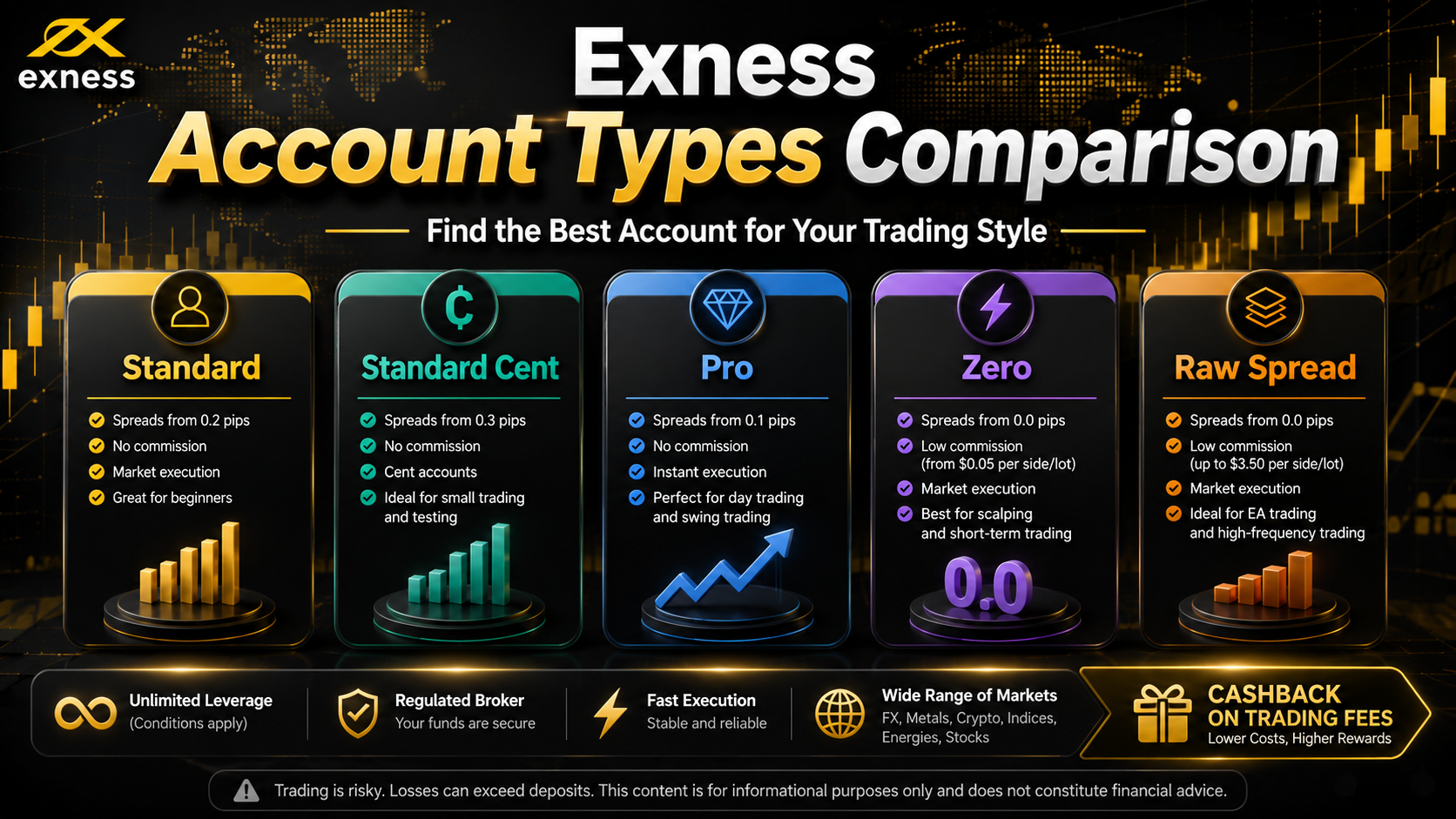
If you are considering opening an Exness account, you may be wondering which account type is the best fit for your trading style.
Exness offers beginner-friendly options such as the Standard account and Standard Cent account, as well as professional account types designed for traders who prioritize tighter spreads: the Pro account, Zero account, and Raw Spread account.
Each account differs in spreads, commissions, execution method, funding requirements, and the trading strategies it suits best. Choosing the right account can therefore affect not only trade execution, but also your long-term transaction costs.
In this guide, we compare the five main Exness account types and explain which options may be suitable for beginners, scalpers, Expert Advisor users, discretionary traders, and gold traders. We also explain how eligible clients may reduce effective trading costs through a cashback arrangement.
The Two Main Categories of Exness Accounts
Exness account types can broadly be divided into two categories: Standard accounts and Professional accounts.
- Standard accounts: Standard and Standard Cent
- Professional accounts: Pro, Zero, and Raw Spread
Standard accounts have no separate trading commission and are relatively easy to understand, making them accessible to both new and experienced traders. Professional accounts generally require a higher initial deposit, but provide tighter spreads or execution conditions designed for more specific trading styles.
Minimum deposits, available account types, leverage, payment methods, and account currencies may vary depending on your country of residence, the Exness entity serving your account, and the payment method you use. Always confirm the actual conditions shown in your Personal Area after registration.
Exness Account Types Comparison

| Account Type | Spreads | Commission | Execution | Main Feature | Best Suited For |
|---|---|---|---|---|---|
| Standard | From 0.2 pips | No commission | Market execution | Simple all-purpose account | Beginners and discretionary traders |
| Standard Cent | From 0.3 pips | No commission | Market execution | Small-volume trading in cents | Low-risk practice and EA forward testing |
| Pro | From 0.1 pips | No commission | Mainly instant execution | Tighter spreads without a separate commission | Discretionary and day traders |
| Zero | From 0 pips | From $0.05 per lot per side | Market execution | Zero-spread periods on selected instruments | Scalpers and short-term traders |
| Raw Spread | From 0 pips | Up to $3.50 per lot per side | Market execution | Raw spreads with a capped commission structure | EAs, high-frequency strategies, and cost-focused traders |
Some Exness accounts may display “unlimited leverage,” but this is subject to eligibility requirements involving account equity, trading history, economic news, instruments, weekends, and the applicable Exness entity. It is not available unconditionally at all times.
Standard Account: Features and Benefits
The Standard account is the most straightforward Exness account type. There is no separate trading commission, so the spread is normally the main transaction cost.
- Spreads from 0.2 pips
- No separate trading commission
- Market execution with no requotes
- Minimum trade size of 0.01 lots
- Access to forex, metals, cryptocurrencies, energies, stocks, and indices, subject to regional availability
The Standard account is a practical choice for traders who want a simple cost structure or who are trying Exness for the first time. Expert Advisors are supported, although high-turnover EAs may incur higher spread costs than they would on some Professional account types.
Who Should Consider the Standard Account?
- Traders opening their first international CFD trading account
- Anyone who prefers an account with no separate commission
- Swing traders or traders with a relatively low number of transactions
- Traders who want access to multiple asset classes from one account
Standard Cent Account: Features and Benefits
The Standard Cent account displays balances and trade volumes in cents. For example, a deposit of $5 may be shown as 500 USC in the trading account.
Because positions can be opened in smaller units than on a conventional account, this account can be useful for traders moving from a demo environment to live trading or testing an EA with limited capital.
- Spreads from 0.3 pips
- No separate trading commission
- Cent-lot position sizing
- Useful for observing real execution with limited financial exposure
- A more limited instrument selection than the Standard account
The Standard Cent account is useful for small-scale trading, but available instruments and account currencies are restricted. Traders who later want broader market access may consider adding a Standard or Professional account.
Pro Account: Features and Benefits
The Pro account offers tighter advertised spreads than the Standard account without charging a separate trading commission. Spreads are advertised from 0.1 pips. Forex, metals, energies, stocks, and indices generally use instant execution, while cryptocurrencies and certain other instruments use market execution.
This makes the Pro account a balanced option for discretionary traders who want lower spreads without calculating a separate commission. However, instant execution can result in requotes during fast-moving markets.
- Spreads from 0.1 pips
- No separate trading commission
- Instant execution on many major CFDs and market execution on selected instruments
- Minimum initial deposit may start from the equivalent of $200, depending on region
Who Should Consider the Pro Account?
- Traders who want both tighter spreads and no separate commission
- Discretionary day traders
- Standard account users seeking lower spread costs
- Traders who prefer costs to remain embedded in the spread
Zero Account: Features and Benefits
The Zero account is designed to offer zero-spread periods on selected popular instruments. A commission is charged separately and starts from $0.05 per lot per side, depending on the instrument.
For scalpers who open and close positions frequently, spread size can materially affect results. The Zero account may therefore be attractive when the total spread-plus-commission cost is low on the instruments you trade most often, such as major currency pairs or gold.
Despite the name, spreads are not guaranteed to remain at zero on every instrument or at every time. Spreads may widen during major news releases, periods of thin liquidity, the weekly market open, or rollover.
Who Should Consider the Zero Account?
- Scalpers trading major instruments
- Traders who want the smallest possible entry spread on eligible instruments
- Experienced traders comfortable comparing instrument-specific commissions
- Users of short-term EAs or high-frequency strategies
Raw Spread Account: Features and Benefits
The Raw Spread account combines very tight spreads with a separate commission. Spreads are advertised from 0 pips, while commission is advertised at up to $3.50 per lot per side.
Because the commission structure is relatively predictable and spreads can be very low, the Raw Spread account is often well suited to Expert Advisors, scalping systems, and high-turnover trading strategies. It can also make it easier to include transaction costs in backtests and trading plans.
For traders who place only a small number of trades or use very small position sizes, a commission-free Standard or Pro account may still be easier to manage. Always compare the full round-turn cost rather than the spread alone.
Who Should Consider the Raw Spread Account?
- Traders running EAs over the long term
- Scalpers and high-frequency traders
- Traders who want to quantify transaction costs precisely
- Traders who prioritize tight spreads and market execution
Recommended Account by Trading Style
| Trading Style or Goal | Suggested Account | Why |
|---|---|---|
| Beginner | Standard | Simple commission-free structure |
| Small-scale live practice | Standard Cent | Lower financial exposure through cent-based sizing |
| Discretionary day trading | Pro | Tighter spreads without a separate commission |
| Scalping | Zero / Raw Spread | Potentially lower spread costs |
| Expert Advisors and automated trading | Raw Spread | Transaction costs are easier to model |
| Short-term gold trading | Zero / Raw Spread | Tighter spreads may be useful for short holding periods |
| Swing trading | Standard / Pro | Fewer trades can make commission-free pricing more attractive |
Best Exness Account for Beginners
For most first-time Exness users, the Standard account is the easiest place to begin. Its commission-free structure makes profit and loss calculations straightforward and allows you to learn the platform, deposits, withdrawals, and execution environment before moving to a more specialized account.
Once trading frequency increases and spread costs become more important, you can add a Pro, Zero, or Raw Spread account. Exness allows multiple trading accounts within the Personal Area, making it possible to separate discretionary trading, EAs, and individual instruments.
Best Exness Account for Scalping and EAs
For scalping and automated trading, the Raw Spread and Zero accounts are usually the main candidates.
- Raw Spread: Easier to model costs around a defined commission structure
- Zero: May allow traders to benefit from zero-spread periods on eligible instruments
The best account still depends on the EA logic and the instrument traded. Very short holding periods increase sensitivity to spreads, while high trade frequency increases the impact of both commissions and cashback.
Where possible, compare the same strategy on a demo account or a small live account and evaluate actual results after spreads, commissions, and slippage.
Best Exness Account for Gold Trading
XAUUSD is highly volatile and its spread can change significantly by session and market conditions. For trades held for only a few minutes or hours, the Zero or Raw Spread account may be worth considering.
For positions held for several hours or days, position sizing, stop-loss distance, and swap conditions may matter more than a small difference in entry spread. In these cases, the commission-free Standard or Pro account may also be competitive.
Important Points When Choosing an Exness Account
Do Not Compare Spreads Alone
Zero and Raw Spread accounts charge a separate commission. Compare the full round-turn trading cost, including both the spread and commission.
Minimum Deposits Vary by Region and Payment Method
The minimum deposit for Standard accounts depends on your payment method and region. The initial deposit for Professional accounts may start from the equivalent of $200 in some regions. The amount shown in your Personal Area takes priority.
Maximum Leverage Is Subject to Conditions
Even when unlimited leverage is displayed, leverage may be restricted based on account equity, completed trades, major economic events, weekends, and instrument-specific rules. High leverage reduces margin requirements but can also make it easier to take an excessively large position.
Availability Depends on Your Country of Residence
Exness does not provide services to residents of certain countries and regions. This article is not directed at residents of jurisdictions where Exness services or related promotions are restricted. Confirm availability, local laws, and the applicable Exness entity before registering.
Frequently Asked Questions
Can I Change My Account Type After Opening an Account?
You generally cannot directly convert an existing trading account into another type. Instead, open an additional account type from your Personal Area and use the accounts separately.
Can I Use Multiple Account Types at the Same Time?
Yes. You can create multiple trading accounts and separate them by purpose, such as discretionary trading, Expert Advisors, or gold trading. Account limits may vary by platform, server, and other conditions.
Should I Use MT4 or MT5?
Choose the platform based on compatibility with your existing Expert Advisors and indicators. MQL4 programs run on MT4, while MQL5 programs run on MT5. New discretionary traders may prefer MT5 after confirming that their required instruments and tools are supported.
Which Exness Account Has the Lowest Trading Cost?
There is no single cheapest account for every trader. The result depends on the instrument, trading session, lot size, and trade frequency. Zero may be cheaper for some instruments, Raw Spread for others, while Pro may be competitive for lower-frequency traders who prefer no separate commission.
Reduce Effective Trading Costs with an Exness Cashback Account
If you trade with Exness regularly, the availability of cashback can be just as important as the account type itself.
Eligible clients who register through our dedicated Exness link may be able to receive cashback based on trading volume while retaining the standard trading conditions available for their account. Because part of the cost generated through spreads or commissions may be returned, cashback can make a meaningful long-term difference for scalpers, EA users, and other high-volume traders.
- Use the normal Exness trading environment
- Receive cashback based on eligible trading volume
- Suitable for discretionary trading, EAs, and scalping
- May reduce the effective burden of trading costs already incurred
When the account type and trades are otherwise the same, opening an eligible account through a cashback route may reduce your effective trading costs.
Learn how the Exness cashback account works
Eligibility requirements, cashback rates, qualifying instruments, and payment methods may change. Review the latest terms before opening an account.
Conclusion
Exness offers five main account types: Standard, Standard Cent, Pro, Zero, and Raw Spread.
- Beginners: Standard
- Small-scale live trading: Standard Cent
- Discretionary day trading: Pro
- Scalping: Zero or Raw Spread
- EAs and high-frequency trading: Raw Spread
Do not choose an account based only on the advertised minimum spread. Compare the full cost of spreads, commissions, execution method, instruments, and trading frequency.
If you expect to trade regularly, an eligible cashback arrangement may further reduce effective costs. Select the account that matches your strategy and always use responsible position sizing and risk management.
Last updated: July 27, 2026
Risk warning and disclaimer: This article is provided for general informational purposes only and does not constitute investment advice, a personal recommendation, or an offer in any jurisdiction where such an offer would be unlawful. CFDs and leveraged forex products carry a high risk of losing money. Service availability, account conditions, legal requirements, tax treatment, and client protections vary by country of residence and the Exness entity serving the account. Always review the latest official information and trade only after assessing whether the products are appropriate for your circumstances.
Official References


Comments