

Exness is an international CFD broker known for offering high-leverage trading conditions that allow traders to control relatively large positions with a comparatively small amount of margin. Depending on the trader’s region, account type, trading history, and applicable entity, leverage of up to 1:2,000 may be available, while eligible clients may also be able to select “unlimited leverage.”
However, the same leverage does not apply at all times. The effective leverage and margin required for a trade may change depending on the account’s equity, the instrument being traded, major economic news, market closures, weekends, holidays, and Exness’s Higher Margin Requirements (HMR).
This guide explains Exness’s maximum leverage, the requirements for unlocking unlimited leverage, how margin is calculated, when leverage restrictions may apply, and the key differences between forex, gold, cryptocurrencies, stocks, and indices.
Key Takeaways
- Exness may offer leverage of up to 1:2,000 under standard conditions.
- Eligible traders may be able to unlock unlimited leverage after meeting specific requirements.
- Maximum leverage decreases in stages as account equity increases.
- Higher Margin Requirements may apply around major news events, weekends, holidays, and market closures.
- Cryptocurrencies, stocks, indices, and certain commodities may use fixed margin requirements rather than the account’s selected leverage.
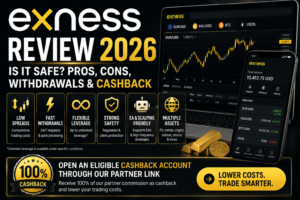
- Accounts opened through our dedicated link may qualify for our highest available cashback rate based on trading volume.
What Is Leverage at Exness?

Leverage allows you to open a position that is larger than the amount of money deposited in your trading account. Your funds are used as margin, while the broker provides access to a larger notional trading amount.
For example, with 1:1,000 leverage, a margin deposit of 100 USD could theoretically support a position with a notional value of up to 100,000 USD. The actual margin required depends on the instrument price, contract size, lot size, account currency, and the leverage or margin rate applied at the time of the trade.
Higher leverage reduces the amount of margin required, but it does not guarantee higher profits. If a trader increases position size, even a small market movement can create a large profit or loss.
What Is the Maximum Leverage at Exness?
Depending on the trader’s country of residence, regulatory entity, account, and eligibility, Exness may allow traders to select unlimited leverage. Traders who do not qualify for unlimited leverage may still be able to choose leverage of up to 1:2,000.
| Account Equity | Maximum Selectable Leverage |
|---|---|
| 0–4,999.99 USD | Unlimited if eligible / otherwise up to 1:2,000 |
| 5,000–29,999.99 USD | Up to 1:2,000 |
| 30,000–99,999.99 USD | Up to 1:1,000 |
| 100,000 USD or more | Up to 1:500 |
The relevant figure is generally account equity rather than account balance. Equity includes unrealized profits and losses on open positions.
This means that if a large floating profit pushes your equity into a higher tier, the maximum leverage available on the account may be reduced. The margin required for existing or new positions may therefore increase, so traders holding multiple positions should monitor free margin carefully.
Requirements for Unlocking Unlimited Leverage
Unlimited leverage is not normally available immediately after opening an account. According to the Exness Help Center, the main eligibility requirements may include the following:
- At least 10 closed real-account trades, excluding pending orders such as limit and stop orders.
- A combined trading volume of at least 5 standard lots across real accounts. For Standard Cent accounts, the equivalent requirement may be 500 cent lots.
- Equity below 5,000 USD in the trading account where unlimited leverage will be selected.
- The trader must be registered under a region, legal entity, and account type where unlimited leverage is available.
Once the conditions have been met, open the account settings in the Exness Personal Area and select unlimited leverage if the option is displayed.
Important: Unlimited leverage can reduce the required margin to an extremely low level, but it also makes it much easier to open oversized positions. A relatively small adverse move may cause the margin level to fall rapidly. Position size should therefore remain conservative.
Does Maximum Leverage Vary by Account Type?
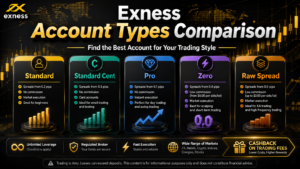
Exness generally applies the same broad leverage structure to Standard, Pro, Raw Spread, and Zero accounts. In eligible regions, traders using these accounts may be able to select unlimited leverage after meeting the required conditions.
| Account Type | Maximum Leverage | Main Features |
|---|---|---|
| Standard | Unlimited if eligible | No separate trading commission on many instruments and suitable for a wide range of traders |
| Standard Cent | Unlimited if eligible | Smaller contract units that may be useful for testing strategies with lower nominal exposure |
| Pro | Unlimited if eligible | Lower spreads and instant execution on supported instruments |
| Raw Spread | Unlimited if eligible | Tighter raw-style spreads with a separate commission structure |
| Zero | Unlimited if eligible | Zero-spread periods on selected major instruments, subject to account conditions |
The leverage selected at account level does not automatically apply to every instrument or every market condition. Instruments with fixed margin requirements may use their own margin rate, which takes priority over the leverage selected for the account.
How to Calculate Required Margin
For instruments that use dynamic margin, required margin can be estimated using the following basic formula:
Required Margin = Lot Size × Contract Size ÷ Leverage
Example: Trading 1 Lot of EURUSD
Assuming a standard forex contract size of 100,000 units, the approximate margin required to hold 1 lot of EURUSD would be as follows:
| Applied Leverage | Approximate Required Margin |
|---|---|
| 1:500 | Approximately 200 EUR |
| 1:1,000 | Approximately 100 EUR |
| 1:2,000 | Approximately 50 EUR |
If the account is denominated in another currency, the required margin will be converted using the applicable exchange rate. The actual figure may differ when HMR or a fixed margin rate applies.
When Does Exness Restrict Leverage?
Exness may apply Higher Margin Requirements to reduce exposure during periods when market volatility or gap risk is expected to increase.
Before and After Major Economic News
Major announcements such as US Nonfarm Payrolls, Federal Reserve decisions, inflation data, employment reports, and central-bank interest-rate decisions can cause sudden price movements. New orders opened around these events may require more margin than usual.
The instruments and time windows affected by HMR may depend on the importance of the news and prevailing market conditions. Before opening a highly leveraged position near a major announcement, review the margin requirement shown in the Exness Personal Area or trading platform.
Around Weekends, Holidays, and Market Closures
Exness states that margin requirements may change around weekends, public holidays, and market closures. As a general rule, HMR may apply during the final hours before a weekend close and shortly after the market reopens, although the exact window can vary.
This is particularly important for expert advisors that add positions late on Friday or strategies that trade the opening gap after the weekend. The required margin may be significantly higher than during normal market hours.
When Account Equity Increases
When account equity exceeds the relevant thresholds—such as 5,000 USD, 30,000 USD, or 100,000 USD—the maximum available leverage may decrease in stages. Unrealized profits are included in equity, so a large floating profit may also move the account into a lower-leverage tier.
Leverage Rules by Instrument
To understand leverage at Exness, it is important to distinguish between dynamic margin and fixed margin.
- Dynamic margin: Margin changes according to the account’s selected leverage, account equity, and current trading conditions.
- Fixed margin: An instrument-specific margin rate takes priority, meaning the account’s selected leverage may not apply.
Forex Currency Pairs
Major and many minor currency pairs generally use dynamic margin, allowing the selected account leverage to affect the required margin. Some exotic pairs may be subject to separate or fixed margin rules.
Gold and Other Metals
XAUUSD is one of the most popular instruments at Exness. Account leverage may apply under normal conditions, but HMR can be introduced around major news releases or market closures. Other metals and commodities, including platinum, palladium, and copper, may use instrument-specific margin rates or fixed leverage.
Cryptocurrencies
Cryptocurrency CFDs such as BTCUSD and ETHUSD commonly use fixed margin requirements that are separate from the account’s maximum leverage. For example, a fixed margin rate of 0.25% is mathematically equivalent to approximately 1:400 leverage, although the required margin may rise during an HMR period.
Stocks and Stock Indices
Stock CFDs and index CFDs may also use instrument-specific fixed margin requirements. Conditions can change around earnings releases, dividend adjustments, trading-session changes, holidays, and market closures. Always check the contract specifications before placing an order.
How to Change Leverage at Exness
- Log in to the Exness Personal Area.
- Open “My Accounts” and select the relevant trading account.
- Open the account settings menu and choose the option to change maximum leverage.
- Select the desired leverage and confirm the change.
The options shown will depend on account equity, trading history, country of residence, Exness legal entity, account type, and product availability. If unlimited leverage is not displayed, review the eligibility requirements and confirm that it is available in your region.
Benefits of High Leverage at Exness
Lower Margin Requirement
Higher leverage reduces the margin required for the same position size. This leaves more free margin available in the account, which can be helpful for traders who monitor several currency pairs or use expert advisors that hold multiple positions.
More Free Margin Without Increasing Position Size
High leverage does not need to be used to open larger positions. It can instead be used to reduce locked margin while keeping the same lot size. When position size remains unchanged, higher leverage can provide a larger margin buffer.
Suitable for Scalping and Automated Trading
Scalping strategies and expert advisors may place several orders within a short period. Higher leverage can help reduce margin usage, making it easier to manage multiple trading opportunities without committing excessive funds as margin.
Disadvantages and Risks of High Leverage
It Becomes Easier to Open Oversized Positions
When the required margin is low, traders can open a position that is too large relative to the account balance. Leverage itself does not automatically increase the loss on a fixed position size; the main risk is using high leverage to increase the number of lots traded.
A Small Adverse Move Can Cause a Large Loss
Oversized positions in volatile instruments such as gold and cryptocurrencies can lose a substantial portion of the account within a short period. Even when a stop-loss order is used, slippage may occur during fast markets or price gaps.
Margin Requirements Can Increase During HMR
If position size is calculated only using normal margin conditions, free margin may become insufficient when HMR is applied around a major news event or market closure. Traders should keep a meaningful margin buffer and avoid using all available margin.
Recommended Leverage for Beginners
Beginners do not need to use unlimited leverage from the start. Selecting leverage in the range of 1:500 to 1:1,000 while limiting the potential loss on each trade to approximately 1% of account equity is a more conservative approach.
| Trading Style | Example Leverage | Risk Management Consideration |
|---|---|---|
| Beginner forex trader | 1:500–1:1,000 | Keep the planned loss per trade around 1% of account equity |
| Scalping | 1:1,000–1:2,000 | Manage risk through lot size and stop-loss distance rather than leverage alone |
| Expert advisor trading | 1:1,000–1:2,000 | Check the maximum number of positions and historical maximum drawdown |
| Advanced short-term trading | Unlimited may be considered | Use it primarily to reduce margin, not to maximize position size |
The most important figure is not the leverage ratio itself, but the amount that will be lost if price reaches the stop-loss level. Before entering a trade, calculate the maximum potential loss using the entry price, stop-loss price, and lot size.
Why Consider an Exness Cashback Account?
Traders who use Exness regularly may be able to reduce their effective trading costs by opening an account through a cashback partner rather than registering through a standard direct link.
When an eligible Exness account is opened through our dedicated link, it may qualify for our highest available cashback rate. Cashback is calculated according to eligible trading activity and can be particularly valuable for scalpers, high-frequency discretionary traders, and expert advisor users who generate consistent trading volume.
- Core Exness trading conditions remain subject to the same Exness account rules.
- Eligible trading activity may generate cashback based on volume.
- Cashback can help reduce the effective cost of frequent trading and automated strategies.
- Standard, Pro, Raw Spread, Zero, and other supported account types may be eligible.
- Eligible clients may also receive access to selected free expert advisors or our trading community, subject to separate conditions.

If you already have an Exness account, it may not be possible to convert the existing account into a cashback-eligible account. Review our cashback registration guide for the applicable eligibility rules and account-opening procedure.
Frequently Asked Questions About Exness Leverage
Does Exness Really Offer Unlimited Leverage?
Unlimited leverage may be available for eligible accounts in supported regions after the trader meets the required number of closed trades, trading-volume requirement, equity limit, and other conditions. Fixed-margin instruments and HMR periods may still override the unlimited setting.
Why Is Unlimited Leverage Not Displayed?
Possible reasons include insufficient trading history, total volume below the required threshold, equity of 5,000 USD or more, an unsupported country or legal entity, or an account type that does not offer unlimited leverage.
Does Increasing Leverage Automatically Increase My Loss?
No. If the lot size remains the same, the profit or loss caused by a given price movement is generally unchanged. The main reason losses become larger is that high leverage allows the trader to open a larger position.
Can Gold Be Traded With Unlimited Leverage?
The account’s leverage setting may apply to XAUUSD under normal conditions, but HMR may increase margin around major economic news, weekends, holidays, and market closures. Check the live contract specifications and margin requirement before trading.
Can Cryptocurrencies Be Traded at 1:2,000?
Not necessarily. Cryptocurrency CFDs commonly use instrument-specific fixed margin rates. Even if the account is set to 1:2,000 or unlimited leverage, that setting may not apply directly to BTCUSD, ETHUSD, or other cryptocurrency instruments.
Are Leverage Conditions Different on a Cashback Account?
Accounts opened through our cashback link generally follow the same Exness leverage, margin, and trading rules as comparable standard accounts. Cashback is an additional rebate linked to eligible trading activity and does not replace the broker’s normal trading conditions.
Conclusion
Exness may offer leverage of up to 1:2,000 under standard conditions, while eligible traders in supported regions may be able to select unlimited leverage. This can make Exness attractive to traders who value margin efficiency, scalping, or automated trading.
At the same time, maximum leverage changes according to account equity, and higher margin may be required around major economic events, weekends, holidays, and market closures. Some instruments, including cryptocurrencies, stocks, indices, and selected commodities, may use fixed margin requirements that override the account’s selected leverage.
High leverage is best used to reduce required margin and preserve free margin—not to increase lot size to the maximum possible level. Always calculate the planned loss at the stop-loss level and keep position size appropriate for the account balance and strategy drawdown.
Traders who plan to use Exness regularly may also reduce effective trading costs by opening an eligible account through our dedicated cashback link. This can be especially useful for scalpers and expert advisor users who trade frequently.
Official References
- Exness Help Center: Leverage
- Exness Help Center: Unlimited Leverage
- Exness Help Center: Margin
- Exness Help Center: Higher Margin Requirements
- Exness Help Center: Trading Calculator
Risk Warning: Forex and CFD trading involves leverage and carries a high risk of losing some or all of your deposited funds. This article is provided for informational purposes only and does not constitute investment advice, financial advice, or a guarantee of trading results. Account availability, maximum leverage, tradable instruments, cashback eligibility, and other conditions vary by country of residence, Exness legal entity, regulation, account type, and time. Always review the latest information on the official Exness website and confirm the applicable terms before opening an account or placing a trade.


Comments