
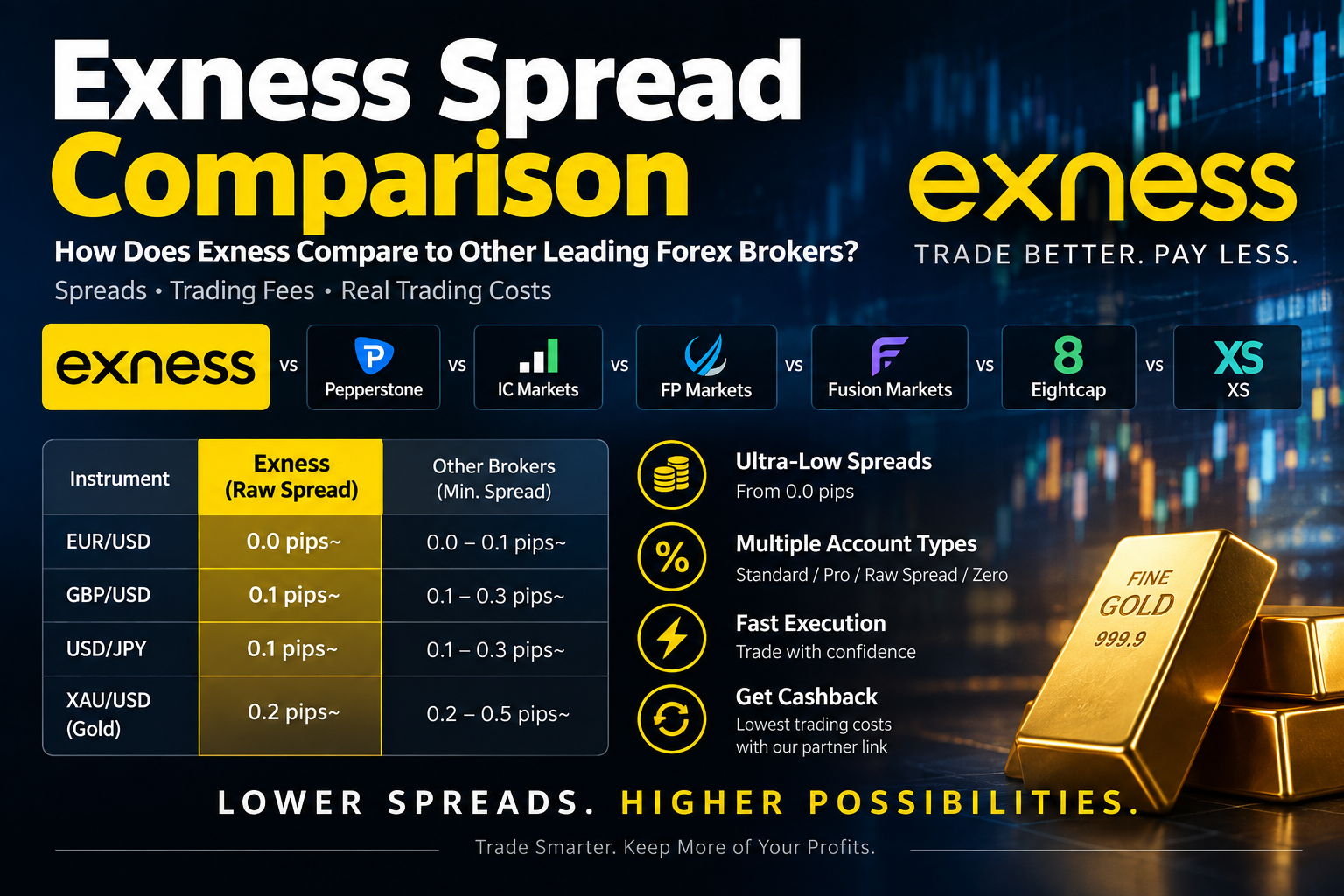
When choosing a forex and CFD broker, spreads are one of the most important trading-cost factors to consider. For scalpers, day traders and Expert Advisor users who place a large number of trades, even a small difference in spread can have a meaningful effect on monthly and annual performance.
Exness offers several account types with different pricing structures, including Standard, Standard Cent, Pro, Raw Spread and Zero accounts. As a result, it is not enough to ask whether “Exness spreads are low.” Traders should also consider commissions, the instruments they trade, execution conditions, trading frequency and any available cashback or rebate.
This guide explains Exness spreads by account type, how to evaluate trading costs on major forex pairs, gold and cryptocurrencies, how Exness compares with internationally recognised brokers, when spreads may widen, and how an Exness cashback account may reduce effective trading costs.
Related guide: How to Open an Exness Cashback Account
Bottom line: Exness provides commission-free Standard and Pro accounts, as well as Raw Spread and Zero accounts designed for tighter quoted spreads. Traders who register through our dedicated partner link may also qualify for our highest available cashback rate, subject to account type, instrument, trading activity and program conditions. Cashback does not change the spread displayed in the trading platform, but it may reduce the effective cost after eligible trades are completed.
What Is the Exness Spread?

The spread is the difference between the ask price and bid price of a currency pair or CFD instrument. A newly opened position normally begins with an unrealised loss approximately equal to the spread, so the spread acts as an immediate trading cost.
For example, if EURUSD is quoted at 1.10010 ask and 1.10000 bid, the difference is 0.00010, or 1.0 pip under the conventional quotation method. The larger the position size and the more frequently a strategy trades, the greater the cumulative spread cost can become.
Exness Uses Variable Spreads
Exness generally uses variable spreads. Spreads may be relatively narrow when liquidity is strong, but they can widen around major economic releases, the weekly market open, rollover, unexpected news, sharp price movements and periods of reduced liquidity.
Figures such as “from 0.0 pips” or “from 0.1 pips” are minimum advertised values. They do not mean that every trade will be executed at that spread. Actual spreads depend on the account type, instrument, time of day, market conditions and the Exness entity serving the client.
Exness Spreads by Account Type
Exness offers Standard, Standard Cent, Pro, Raw Spread and Zero accounts. The principal differences are the quoted spread, commission model, available instruments, minimum deposit requirements and execution method.
| Account Type | Advertised Spread | Trading Commission | Best Suited To |
|---|---|---|---|
| Standard | From 0.2 pips | No separate commission | Beginners, discretionary trading and EAs |
| Standard Cent | Variable | No separate commission | Small-scale trading and forward testing |
| Pro | From 0.1 pips | No separate commission on many instruments | Scalpers and day traders |
| Raw Spread | From 0.0 pips | Up to USD 3.50 per lot, per side | High-frequency strategies and detailed cost control |
| Zero | From 0.0 pips | Instrument-specific, from approximately USD 0.05 per lot, per side | Traders focused on selected major instruments |
Standard Account
The Standard account is Exness’s core account type. It uses spread-only pricing with no separate trading commission. This structure is easy to understand because most transaction costs are included in the spread.
The Standard account can be suitable for discretionary traders and EA users who prefer simple cost calculations. However, very high-frequency scalping strategies may achieve a lower all-in cost on a Raw Spread or Zero account, depending on the instrument and commission charged.
For eligible traders using our cashback arrangement, the Standard account may remain attractive because cashback can be linked to spread-based partner rewards. The effective result depends on trading volume, instrument, spread, order duration and the applicable partner rules.
Standard Cent Account
The Standard Cent account displays the account balance in cents and is designed for smaller position sizes. It can be useful for testing an EA or discretionary method under live market conditions without using a full-size trading balance.
Availability and supported instruments may be limited by country or Exness entity. The account may therefore be more suitable for practice and forward testing than for a large-scale production strategy.
Pro Account
The Pro account combines relatively tight advertised spreads with no separate trading commission on many products. It can provide a useful middle ground for traders who want lower quoted spreads without having to add a fixed commission to every trade.
Instant execution may be available for certain forex, metal, energy and index instruments. Under instant execution, requotes may occur when the requested price is no longer available. Market execution may also apply depending on the instrument and account configuration.
This account may suit discretionary scalpers and day traders who want a cleaner cost structure than a commission-based account while targeting lower spreads than the Standard account.
Raw Spread Account
The Raw Spread account combines spreads from 0.0 pips with a fixed-style commission. For many instruments, the commission can be up to USD 3.50 per lot per side, or up to USD 7.00 for a complete open-and-close transaction.
This account can suit short holding periods, scalping and automated strategies because the quoted spread may remain very tight during liquid periods. However, the commission must always be converted into a comparable cost and added to the spread before deciding whether it is cheaper than a commission-free account.
Zero Account
The Zero account is designed to offer zero spreads on selected instruments for specified portions of the trading day, subject to market conditions and Exness rules. Commission is charged separately and varies by instrument.
The Zero account may be competitive when a trader concentrates on instruments with low commission rates and frequent zero-spread periods. It should not be assumed that every instrument will remain at 0.0 pips at all times. Traders should check live quotes and the instrument-specific commission schedule in MT4 or MT5.
How to Compare Exness Spreads on Major Instruments

Spreads differ not only between account types but also between instruments. EURUSD, GBPUSD, USDJPY, XAUUSD and BTCUSD can each have very different spread behaviour. The same instrument may also show a different spread during the Asian, London and New York sessions.
Rather than relying only on a single screenshot or a minimum value published by a comparison site, measure the spread during the hours in which your strategy actually trades.
- Create an Exness demo or live account.
- Select the account type you intend to use.
- Open Market Watch in MT4 or MT5.
- Record bid and ask prices during your normal trading hours.
- For Raw Spread and Zero accounts, add the round-turn commission.
- Record slippage and execution price for live or forward-test trades.
- Subtract any confirmed cashback from the total cost.
EURUSD
EURUSD is one of the most liquid currency pairs in the world and often has relatively tight spreads. Liquidity generally improves during the overlap between the London and New York sessions, making the pair widely used for scalping, intraday trading and EA testing.
GBPUSD
GBPUSD can offer substantial intraday movement but is often more volatile than EURUSD. Spreads may widen around Bank of England decisions, UK inflation and employment releases, and major US data. Traders should measure both the normal spread and the spread during the specific news windows their strategy may encounter.
USDJPY
USDJPY is active during the Asian session and can remain liquid through London and New York hours. Spreads may widen around Bank of Japan decisions, US economic data, official comments and periods of concern about foreign-exchange intervention.
XAUUSD (Gold)
XAUUSD is popular with discretionary scalpers and EA traders because of its high volatility and around-the-clock weekday trading. However, gold spreads can change much more sharply than major forex spreads, particularly around US payrolls, CPI releases, Federal Reserve decisions and geopolitical shocks.
Gold EA backtests should not rely on an unrealistically low fixed spread. Real tick data, variable spread assumptions, commission, slippage and execution delays should be incorporated wherever possible.
BTCUSD
Cryptocurrency CFDs may be available outside normal forex market hours, including weekends, depending on the account and region. Spreads can widen significantly during rapid price movements or periods of low liquidity. Normal observed spread is therefore more useful than the lowest advertised value.
Exness vs Popular International Forex and CFD Brokers
For an English-speaking audience, Exness is more usefully compared with internationally recognised brokers that are commonly considered by active traders, scalpers and EA users. This section uses Pepperstone, IC Markets, FP Markets, Fusion Markets, Eightcap and XS as comparison points.
Broker websites do not all publish spreads in the same way. Some show minimum spreads, some publish typical or average spreads, and others provide live pricing snapshots. Commission-based accounts may also use different lot definitions, currencies or commission schedules. For that reason, the fairest comparison is:
Effective trading cost = spread + round-turn commission + slippage + financing costs − confirmed cashback
| Broker | Commission-Free Account | Low-Spread Account | Commission Structure | General Positioning |
|---|---|---|---|---|
| Exness | Standard / Pro | Raw Spread / Zero | Raw Spread up to USD 7 round turn per lot; Zero varies by instrument | Wide account choice, flexible cost structures and cashback potential |
| Pepperstone | Standard | Razor | Separate commission on Razor, depending on platform and base currency | Popular with active traders and multi-platform users |
| IC Markets | Standard | Raw Spread | Separate commission on Raw accounts, depending on platform | Widely used by scalpers, algorithmic traders and high-volume clients |
| FP Markets | Standard | Raw | Separate commission on Raw pricing | Competitive forex pricing and multiple platform options |
| Fusion Markets | Classic | Zero | Low separate commission on Zero account | Cost-focused positioning for active traders |
| Eightcap | Standard | Raw | Separate commission on Raw account | Forex and CFD offering with MT4, MT5 and TradingView access in eligible regions |
| XS | Standard / Pro | Elite | Instrument- and account-specific commission | Multiple account tiers and cashback availability through selected partners |
Exness vs Pepperstone
Pepperstone is widely known in English-speaking markets and offers Standard and Razor pricing. The Standard account generally includes trading costs in the spread, while the Razor account uses raw-style spreads plus commission.
The closest Exness comparison is Standard or Pro versus Pepperstone Standard, and Raw Spread versus Pepperstone Razor. Exness Pro may appeal to traders who want tighter advertised spreads without a separate commission, while Pepperstone Razor can appeal to users who prioritise raw pricing and platform choice. Actual performance should be assessed using the same instrument, time window, lot size and platform.
Exness vs IC Markets
IC Markets is frequently considered by scalpers, EA users and algorithmic traders. Its Raw Spread accounts combine tight quoted spreads with a separate commission, while the Standard account uses spread-only pricing.
Exness Raw Spread and IC Markets Raw Spread should be compared using all-in costs rather than minimum spread alone. Traders should also compare execution, slippage, data quality, platform choice, symbol specifications and the trading restrictions applicable to their strategy.
Exness vs FP Markets
FP Markets offers Standard and Raw-style pricing. The Raw account is aimed at traders who prefer lower quoted spreads with commission charged separately.
Exness provides more account-tier options, including Pro and Zero, which can make it easier to choose between commission-free and commission-based pricing. FP Markets may remain competitive for traders who prefer its particular platform, regulatory entity or product range. Live spread and execution testing is essential.
Exness vs Fusion Markets
Fusion Markets positions its Zero account around low commissions and raw spreads. On headline commission alone, Fusion Markets may be cheaper than Exness Raw Spread for some instruments and base currencies.
Exness may still be competitive through its Pro account, instrument-specific conditions, flexible leverage rules where available, and cashback on eligible trading activity. Traders should compare total realised cost rather than assuming that the lowest commission automatically produces the best result.
Exness vs Eightcap
Eightcap offers Standard and Raw pricing and is known in several English-speaking markets. The Raw account uses separate commission, while Standard pricing incorporates costs into the spread.
Eightcap may appeal to traders who value its supported platforms and instrument range. Exness may appeal to traders who want a broader selection of account structures and the option of cashback through an eligible partner arrangement.
Exness vs XS
XS provides several account types, including commission-free and commission-based options. Depending on the region and entity, Pro and Elite accounts may be the most relevant comparisons with Exness Pro and Raw Spread.
Our site provides cashback arrangements for both Exness and XS. The better choice depends on the instruments traded, platform, country of residence, observed spreads, commission, execution, account eligibility and cashback terms.
Conclusion of the Broker Comparison
Exness is not guaranteed to be the cheapest broker for every account type, instrument or trading session. Some competitors may offer a lower commission, a lower average spread on a specific pair, or a platform that is better suited to a particular strategy.
Exness’s main strength is flexibility: traders can choose a straightforward Standard account, a commission-free Pro account, a Raw Spread account or a Zero account. When eligible cashback is included, Exness can become particularly competitive for high-volume traders, EA users and clients who trade several instruments.
Why Comparing Spreads Alone Can Be Misleading
Commission Must Be Added
A headline spread of 0.0 pips may look attractive, but Raw Spread and Zero accounts charge a separate commission. The commission should be converted into an equivalent pip or cash cost and added to the spread.
For example, if one standard lot of EURUSD has an approximate pip value of USD 10 and the round-turn commission is USD 7, the commission is approximately equivalent to 0.7 pips. If the observed spread is 0.1 pips, the simplified all-in cost is approximately 0.8 pips before slippage, financing and cashback.
The exact pip value depends on the currency pair, position size, account currency and exchange rate.
Execution and Slippage Matter
A narrow displayed spread does not guarantee a low realised cost. If orders regularly receive negative slippage, partial fills, requotes or delayed execution, the actual entry and exit cost may be materially higher. This is particularly relevant during news events, in gold and cryptocurrency markets, and for very short-term strategies.
Swap and Financing Costs Matter
For positions held overnight or for several days, swap or financing charges may exceed the initial spread cost. Scalpers and day traders may place more weight on spread and commission, while swing traders should include overnight financing in the comparison.
Cashback Changes the Effective Cost
Two traders using the same Exness account type may have different effective costs if one receives cashback and the other does not. The more eligible volume a trader generates, the larger the cumulative difference may become.
When Exness Spreads May Widen
- Daily rollover: liquidity may decline around the transition between trading days.
- Weekly market open: spreads can widen immediately after trading resumes.
- Major economic releases: employment data, CPI, central-bank decisions and policy announcements.
- Session opens and closes: liquidity can change quickly around major market transitions.
- Unexpected volatility: geopolitical events, official comments, intervention risk and breaking news.
- Instrument-specific events: earnings, contract changes, index rebalancing or cryptocurrency volatility.
EA users should set a maximum-spread filter where appropriate so that new positions are blocked when spreads become abnormal. Discretionary traders should also check the live bid and ask before submitting an order.
Best Exness Account by Trading Style
| Trading Style | Possible Account | Reason |
|---|---|---|
| Beginner | Standard | No separate commission and simple cost structure |
| Small-scale live testing | Standard Cent | Smaller nominal trade sizes where available |
| Discretionary scalping | Pro / Raw Spread | Potentially tighter spreads |
| Day trading | Pro / Standard | Commission-free pricing is easy to manage |
| High-frequency EA | Raw Spread / Zero | Lower quoted spreads may benefit frequent entries |
| Gold EA | Raw Spread / Pro | Allows practical comparison of spread and commission |
| Cashback-focused trading | Eligible Standard, Pro or other supported account | Rebates may reduce effective cost |
The best account cannot be identified from the minimum spread alone. EA users should forward-test the same strategy over the same period on more than one account type and compare final results after spread, commission, slippage, swap and cashback.
Reduce Effective Trading Costs With an Exness Cashback Account
When you open an Exness account through our dedicated partner link, eligible trades may qualify for cashback under our highest available cashback-rate arrangement.
Cashback is funded from a portion of the partner reward generated by eligible trading activity and returned to the trader according to our program terms. It does not directly reduce the bid-ask spread shown in Exness, MT4 or MT5. Instead, it is credited after qualifying trades, thereby reducing the effective cost.
Effective Cost Formula
Effective trading cost = spread + commission + swap and slippage − cashback
For example, if eligible trading activity generates USD 500 in spread-related and other qualifying costs during one month and the trader receives USD 200 in cashback, the effective cost becomes USD 300. This is a simplified illustration. Actual cashback depends on account type, instrument, volume, spread, order duration, partner reward calculation, currency conversion and current program rules.
After opening the partner link, complete registration in the same browser and session whenever possible so the referral is recorded correctly. If you already have an Exness account linked to another partner, it may not be possible to transfer that existing account to our partner arrangement. Confirm eligibility before registration.
Who May Benefit Most From Cashback?
- Scalpers and day traders with a high number of monthly trades
- EA users running strategies on several charts or instruments
- Gold traders whose spread-related costs can accumulate quickly
- Standard or Pro account users seeking a lower effective cost
- High-volume traders who can accumulate meaningful rebates
Cashback does not guarantee profit. However, when two accounts otherwise have the same trading conditions, receiving a rebate on eligible activity can provide a cost advantage.
Frequently Asked Questions About Exness Spreads

Which Exness Account Has the Lowest Spread?
Based on advertised minimums, the Raw Spread and Zero accounts start from 0.0 pips. Both charge a separate commission, so the lowest quoted spread does not necessarily mean the lowest total cost.
Which Exness Account Has Tight Spreads Without Commission?
The Pro account advertises spreads from 0.1 pips with no separate commission on many instruments. It may suit traders who want a simpler fee structure than a Raw Spread account.
Are Exness Spreads Fixed?
No. Exness generally uses variable spreads. The spread may widen as liquidity, volatility, news risk and market conditions change.
Does an Exness Cashback Account Have Wider Spreads?
Our cashback arrangement uses eligible Exness accounts registered through a partner link. We do not independently add a markup to the spread displayed by Exness. Nevertheless, trading conditions can differ by account type, instrument, jurisdiction and Exness policy, so traders should verify live conditions in MT4 or MT5.
Can an Existing Exness Account Receive This Cashback?
An existing account that is already linked to another partner may not be transferable. Traders seeking our cashback arrangement should generally register through the dedicated link before creating the account and confirm the applicable conditions.
Is the Minimum Spread the Same as the Average Spread?
No. A minimum spread is the lowest published or observed value under certain conditions. An average or typical spread represents pricing over a broader period. Never compare one broker’s minimum spread directly with another broker’s average spread without clearly identifying the difference.
Conclusion: Compare Exness Using Total Cost, Not Spread Alone
Exness offers commission-free Standard and Pro accounts as well as Raw Spread and Zero accounts with spreads from 0.0 pips. This gives traders several ways to structure transaction costs according to their trading style.
- Standard: advertised spreads from 0.2 pips with no separate commission
- Pro: advertised spreads from 0.1 pips with no separate commission on many instruments
- Raw Spread: advertised spreads from 0.0 pips with commission up to USD 3.50 per lot per side
- Zero: advertised spreads from 0.0 pips with instrument-specific commission
- Total-cost comparisons should include spread, round-turn commission, slippage and financing
- Eligible cashback may reduce the effective cost for traders registering through our partner link
For high-frequency traders, a small cost difference can materially affect net performance. Choose an account using observed trading costs during your actual trading hours, not only the lowest number shown on a broker website.
Risk and availability notice: Forex and CFDs are leveraged, high-risk products. You may lose all of the capital deposited into your trading account. Cashback returns only part of an eligible trading-related partner reward and does not guarantee profit, prevent losses or reduce market risk. Product availability, account types, leverage, payment methods, investor protections and legal terms vary by country and contracting entity. Exness does not provide services to residents of the United States, the United Kingdom, the European Union and certain other restricted jurisdictions. Confirm your eligibility and review the latest official legal documents before registering or trading.
Comments